A Technical Overview for Global Importers
Introduction: The Rise of a Premium Biomass Fuel
In the evolving global energy landscape, the search for sustainable, high-performance fuel alternatives has intensified. Among the most promising solutions is the coconut shell charcoal briquette—a product that transforms agricultural waste into a premium energy source. Indonesia, as the world’s second-largest coconut producer with over 3.6 million hectares of coconut plantations, is uniquely positioned to supply this growing international demand.
The superiority of Indonesian coconut shell charcoal briquettes lies not only in their abundant raw material but in their exceptional combustion characteristics. The dense, fibrous structure of coconut shells produces charcoal with a calorific value ranging from 6,161 to 7,110 calories per gram, significantly higher than many other biomass sources. This inherent energy density, combined with minimal ash content and a clean, smokeless burn, makes Indonesian briquettes the preferred choice for shisha, barbecue, and industrial applications across Europe, America, the Middle East, and Japan.
This article provides a comprehensive overview of the production process, quality parameters, and market advantages of Indonesian coconut shell charcoal briquettes for discerning international buyers.
The Production Process: From Coconut Shell to Premium Briquette
The transformation of raw coconut shells into export-grade charcoal briquettes involves a carefully controlled multi-stage process. Leading Indonesian manufacturers maintain rigorous quality control at each stage to ensure product consistency and performance.
Stage 1: Raw Material Selection and Carbonization
The process begins with the careful selection of high-quality coconut shells. Producers often source from their own plantations or established supply chains to ensure raw material quality and supply stability. The selected shells are subjected to a carbonization process—a controlled pyrolysis that converts the biomass into charcoal. This is typically achieved through a slow-burning method in closed drums with limited ventilation, producing a high-quality carbonized material ready for further processing.
Stage 2: Crushing and Sieving
The carbonized shells are processed through grinding equipment, typically a disk mill, to produce fine charcoal powder. Particle size is a critical factor at this stage, as it directly influences the physical properties of the final briquette. Research has demonstrated that smaller particle sizes, such as 35 mesh (approximately 0.5 mm), produce briquettes with superior mechanical durability and combustion efficiency. For export-grade products, 40 mesh powder is often specified as standard to achieve the required density and compressive strength.
Stage 3: Adhesive Mixing and Blending
The charcoal powder is then mixed with a binder system—traditionally tapioca flour (cassava starch) at approximately 5% concentration by weight, combined with water. The choice of adhesive significantly influences the briquette quality. Research comparing tapioca flour, cassava flour, and modified cassava flour adhesives revealed that briquettes with tapioca flour demonstrated superior compressive strength (6.95 N/mm²) and friability performance (4.44%) compared to other formulations.
Tapioca starch is particularly valued for its renewable, biodegradable nature and non-toxic combustion characteristics. It provides excellent adhesive properties with minimal combustion by-products. The mixture is thoroughly blended using specialized mixing equipment to achieve a uniform consistency.
Stage 4: Molding and Extrusion
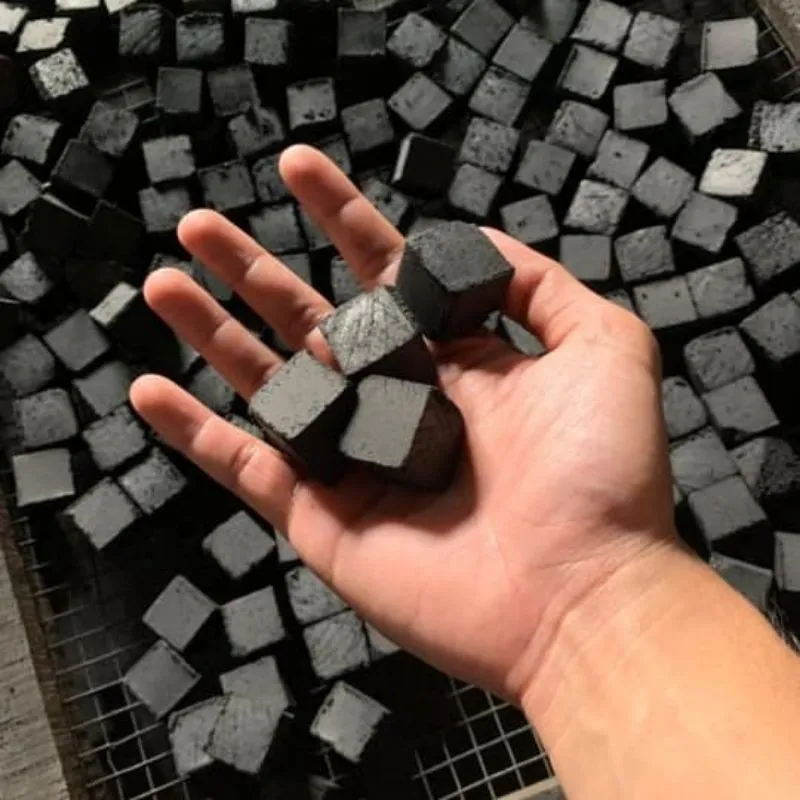
The uniform mixture is fed into molding or extrusion equipment to form the desired briquette shape. Modern production frequently utilizes screw extruder machines operating at approximately 1,650 rpm to produce consistent, high-density briquettes. This method allows for efficient, continuous production and enables customization of shapes including pillow, cube, finger, and hexagonal forms.
The briquette shape and size are determined by end-use application. For the Middle Eastern shisha market, specific geometries are preferred to ensure optimal burn characteristics. For barbecue applications in European and American markets, different configurations are supplied.
Stage 5: Drying
Freshly molded briquettes contain significant moisture—typically 25-30% from the mixing process. This must be reduced to below 8% to meet international quality standards and ensure proper combustion characteristics. The drying stage is the most energy-intensive phase of production, consuming over 90% of the total energy required for briquette manufacturing.
Two drying technologies are commonly employed: diesel oil-fueled dryers (achieving heat efficiency of approximately 78.6%) and biomass-fueled dryers (approximately 76% efficiency). The drying process typically uses temperatures around 100°C for approximately three hours in industrial ovens. Proper drying is essential to prevent cracking during storage and transportation, ensuring product stability and longevity.
Stage 6: Quality Control and Packaging
Finished briquettes undergo comprehensive quality testing before packaging. Testing typically includes moisture content, ash content, volatile matter, fixed carbon, calorific value, density, compressive strength, and drop tests. Leading exporters provide laboratory test reports with each shipment, confirming compliance with international standards such as the Indonesian National Standard (SNI 01-6235-2000), Japanese, American, and European requirements.
Packaging is carefully designed to maintain quality during transport. Products are typically double-packaged with inner plastic liners and outer cardboard boxes or PP bags, with detailed product specifications printed on each package. Manufacturers often offer buyer’s brand packaging and custom design options for boxes and cartons.
Quality Specifications for International Markets
Global importers should specify quality parameters consistent with established standards. Leading Indonesian manufacturers routinely meet these premium specifications:
| Parameter | Premium Grade Specification | Standard Reference |
|---|---|---|
| Moisture Content | ≤ 5% | ASTM D-3173-17 |
| Ash Content | ≤ 2% | ASTM D-3174-12 |
| Fixed Carbon | ≥ 75% | ASTM D-3172-13 |
| Volatile Matter | < 14% | ASTM D-3175-17 |
| Calorific Value | ≥ 7,000 kcal/kg | ASTM D-240 |
| Compressive Strength | ≥ 6.95 N/mm² | ASTM D-440-07 |
| Friability (Drop Test) | ≤ 4.5% | ASTM D-440-07 |
Manufacturers also emphasize performance characteristics including smokeless, odorless, sparkless combustion with a burning time typically exceeding three hours. The clean burn is particularly valued in the shisha market, where combustion by-products directly affect flavor quality.
Sustainable and Economic Advantages
Indonesian coconut shell briquettes represent a compelling combination of environmental sustainability and economic opportunity. The production utilizes a waste product that would otherwise contribute to agricultural disposal challenges, converting it into a valuable export commodity. Coconut plantations provide a renewable and sustainable supply chain, and leading producers maintain their own plantations to ensure long-term supply stability.
The economic advantages are equally significant. Producers can typically complete a 20-40 foot container order within one month, with robust production capacity supporting regular monthly shipments for long-term contracts. The supply chain is well-established with major export ports such as Semarang (Central Java) providing efficient FOB shipping options.
Strategic Partnership Opportunities
For international importers seeking to diversify their biomass fuel supply, Indonesian coconut shell briquettes offer a premium product with demonstrated market acceptance. Leading manufacturers are prepared to enter long-term contracts with favorable pricing arrangements, offering regular container shipments over extended periods. The combination of high-quality raw materials, sophisticated production processes, and rigorous quality control ensures that Indonesian products meet the demanding specifications of the global market.
The commitment to quality is reflected in the comprehensive certification and documentation provided by reputable producers. Laboratory testing documents from government-accredited institutions accompany each shipment, providing importers with independent verification of product quality and specification compliance.
We invite international importers to explore the possibilities of partnership with Indonesia’s leading coconut briquette producers. Our commitment to quality, supply reliability, and customer satisfaction positions Indonesian briquettes as the premium choice for discerning buyers worldwide.
For inquiries regarding product specifications, contract terms, and supply arrangements, please contact our export team directly.
Indonesian coconut shell charcoal briquettes represent the culmination of sustainable resource utilization, technical excellence, and market-responsive product development. As global demand for clean, efficient biomass fuels continues to grow, Indonesia stands ready to meet that demand with products of exceptional quality and consistency.